What Makes a Tank Food Grade
Being stainless does not make a tank food grade. The material has to suit the product, and every surface the product touches has to be smooth, free-draining and easy to clean, with nothing that can trap residue and grow bacteria.
In Australia, the Food Standards Code (Standard 3.2.3) expects food contact surfaces and equipment to be able to be effectively cleaned and sanitised. International hygienic design guidance, such as EHEDG and 3-A, sets out the same principles in more detail.
In practice, a food grade tank comes down to five things: the right stainless grade, a suitable internal finish, smooth and fully penetrated welds, a design that drains completely, and no dead legs or crevices where product can sit.
This guide covers each of those, then cleaning coverage, fittings, jackets and the documents to ask your fabricator for.
304 vs 316 vs 316L Stainless Steel
These three grades cover most food and beverage tanks. All are austenitic stainless steels; the differences are in molybdenum and carbon content.
| 304 | About 18% chromium and 8% nickel. Good general corrosion resistance and the usual choice for milk, water, beer and many neutral products. Less resistant to chlorides than 316. |
|---|---|
| 316 | Adds about 2 to 3% molybdenum, which improves resistance to pitting and crevice corrosion from chlorides and many acids. Chosen for salty, acidic or aggressive products and cleaning regimes. |
| 316L | Low-carbon 316 (0.03% carbon maximum). Lower carbon reduces the risk of corrosion along welds after fabrication, so it is often specified for welded tanks and pharmaceutical work. |
| 304L | Low-carbon 304, used for the same weld-related reason where 304 is otherwise suitable. |
| Higher alloys | Duplex and other high alloys are used where chlorides, temperature or chemicals are beyond what 316L can handle reliably. |
| Cost | 316 and 316L cost more than 304. |
Choosing the Grade for Your Product
Start with the product, then look at how you clean, because a tank may see hot caustic and acid every day.
Neutral products such as milk, cream, water and beer are commonly held in 304 or 304L. Dairy plants often use 304 for silos and storage and step up to 316 where products are salted or cultured, or where cleaning chemicals are stronger.
Acidic products such as fruit juice, wine, vinegar, sauces and fermented foods usually call for 316 or 316L.
Salty products are where 304 is most at risk. Brines, soy, stocks and salted dressings carry chlorides that can pit 304, especially when warm. 316L is the usual minimum, and very high chloride or high temperature duties may need a higher alloy.
Pharmaceutical and high-purity water systems are normally 316L throughout, often with a finer internal finish.
If you are unsure, send us the product, its temperature range and your cleaning chemicals. We recommend a grade and show it on the approval drawing before fabrication starts. We build in 304, 316, 316L and higher alloys in a stainless-only workshop.
Surface Finish, Welds and Drainability
Internal finish is usually specified by surface roughness, measured as Ra in micrometres. The lower the Ra, the smoother the surface and the less it holds onto product and bacteria. Mill finishes such as 2B can suit simple storage duties, polished finishes are used where cleanability matters more, and electropolishing is common in pharmaceutical work. Food contact surfaces are commonly specified at 0.8 micrometres Ra or smoother.
Specify the finish on the drawing and ask how it will be checked. Our standard finish for food contact surfaces is 0.6 micrometres Ra.
Welds are where hygienic tanks most often fail. Product-contact welds should be fully penetrated, smooth and ground or polished to blend with the surrounding finish. Orbital welding gives consistent bead quality on sanitary pipework, and TIG welding is used on tank shells and fittings. Ask how welds will be inspected.
A food grade tank must drain completely. That means a coned or dished bottom falling to the outlet, an outlet at the lowest point, and no internal ledges, flat surfaces or pockets that hold liquid. Horizontal tanks and pipework need a fall toward the outlet.
Dead legs are short branches or capped tees where liquid sits outside the main flow. Good hygienic design keeps branches as short as possible, often within about two pipe diameters, and places valves close to the main line or tank shell.
CIP and Spray-Ball Coverage
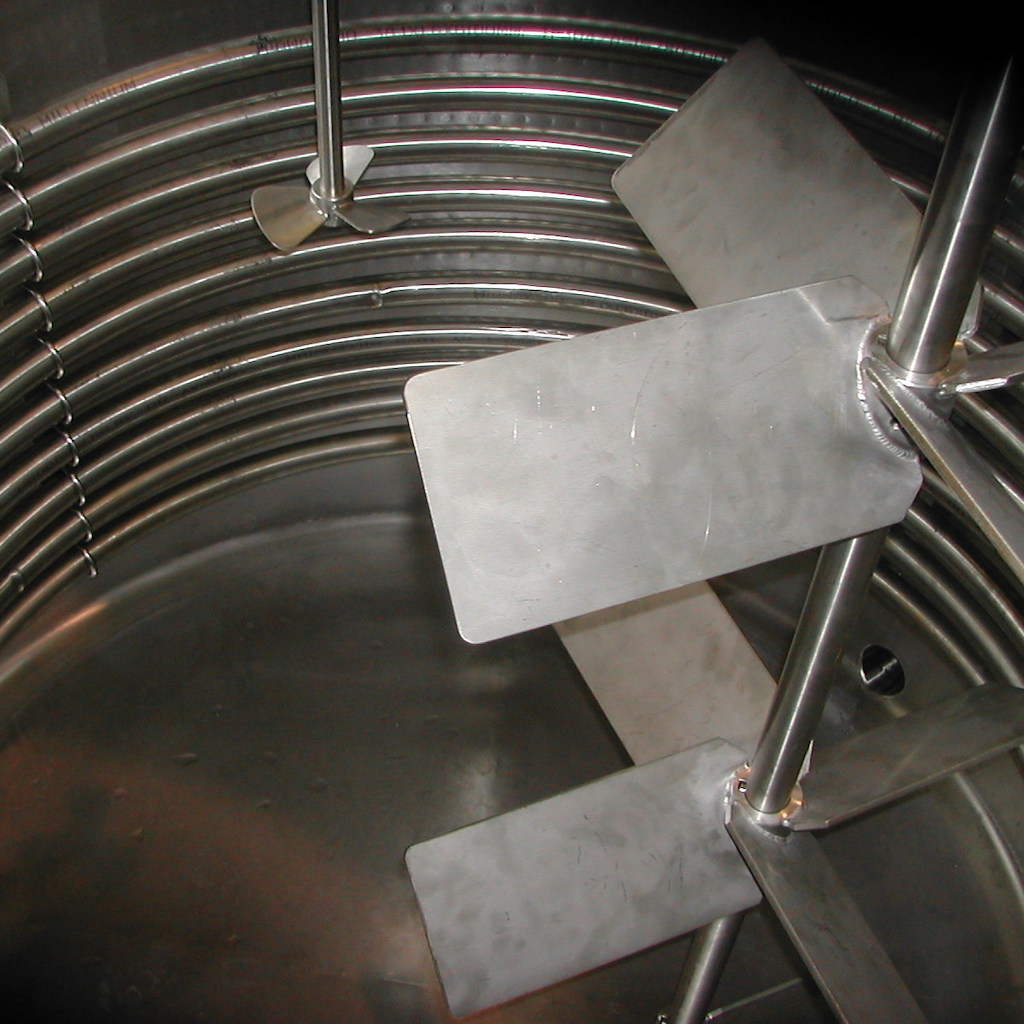
Most food grade tanks are cleaned in place: solution is pumped to a spray device inside the tank, wets every surface, then drains and returns to the CIP set.
The spray device has to reach every internal surface. Static spray balls rely on flow and drainage down the walls. Rotating spray heads and jet heads add mechanical action for heavier soils and larger tanks. Agitators, baffles and dip tubes create shadows, so devices must be positioned around them.
A riboflavin test is the usual way to prove coverage. Riboflavin, vitamin B2, is harmless and glows under ultraviolet light. The inside of the tank is coated with a riboflavin solution, the spray system is run as it would be in production, and the tank is then inspected with a UV lamp. Any glowing patch shows a surface the cleaning solution did not reach.
On the tanks we build, we choose and position spray devices for full coverage. We can also arrange riboflavin coverage testing through a NATA-accredited tester. Our CIP Tank Design Guide covers the cleaning circuit in more detail.
Fittings, Manways, Jackets and Insulation
What to specify for the parts around the shell.
Sanitary Fittings
Use hygienic connections such as tri-clamp or other sanitary unions with food-grade seals. Avoid threads on product-contact surfaces.
Manways
Choose a manway that seals cleanly and can be cleaned in place or easily by hand. Check seal material against your CIP chemicals.
Valves and Instruments
Mount valves, probes and sample points flush or close to the shell to avoid dead legs.
Jackets
Heating or cooling jackets control product temperature with steam, hot water, chilled water or glycol. Size jacket area to the heat-up or cool-down time your process needs.
Insulation and Cladding
Insulation holds temperature and stops condensation. Fully sealed stainless cladding keeps moisture out of the insulation and gives a cleanable outer surface for food plants.
Access and Supports
Plan legs, ladders and platforms early. Leave floor clearance so you can clean under the tank.
Food-Grade Tank Buyer Checklist
Use this list when you brief a fabricator or review a quote. Ask for the documents up front.
| Product | Product, temperature range, pH and salt content, and any solids or viscosity |
|---|---|
| Grade | 304, 316, 316L or higher alloy, shown on the drawing for every product-contact part |
| Internal finish | Specified finish and Ra for product-contact surfaces, and how it will be measured |
| Welds | Fully penetrated, ground or polished product-contact welds; inspection method stated |
| Drainability | Coned or dished bottom, outlet at the low point, no internal ledges or pockets |
| Dead legs | Short branches, valves close to the shell, no capped tees in product lines |
| CIP | Spray device type and position, required flow and pressure, and how coverage will be checked |
| Fittings and seals | Sanitary connections and seal materials suited to product and CIP chemicals |
| Temperature control | Jacket type, area and media; insulation and cladding where needed |
| Drawings | 3D model and approval drawings signed off before fabrication |
| Material certificates | Material certificates for plate, pipe and fittings, collected in the manufacturer's data report |
| Test records | Weld procedure records (WPS/PQR), NDT records and pressure or leak test results, plus any other tests your specification calls for |
| Fabricator | Stainless experience in your industry; ASSDA accreditation is one independent check |
Questions About Food-Grade Tanks
For anything else, call (07) 3348 9444.
Is 304 stainless steel food grade?
Yes. 304 is widely used for food and beverage tanks and suits neutral products such as milk, water and beer. For salty or acidic products, or aggressive cleaning regimes, 316 or 316L is usually the better choice.
What is the difference between 316 and 316L?
316L is the low-carbon version of 316. The lower carbon reduces the risk of corrosion along welds after fabrication, which is why 316L is often specified for welded tanks and pharmaceutical work.
What surface finish does a food grade tank need?
It depends on the product and how the tank is cleaned. Food contact surfaces are commonly specified at 0.8 micrometres Ra or smoother. The finish should be shown on the approval drawing.
How do I know CIP will clean the whole tank?
Ask how coverage will be checked. A riboflavin test is the usual method: the tank is coated with riboflavin, the spray system is run, and any area that still glows under UV light was missed. On the tanks we build, we choose and position spray devices for full coverage. We can also arrange riboflavin coverage testing through a NATA-accredited tester.
Do you build food grade tanks for interstate sites?
Yes. We build tanks from 100L to 250kL in our workshop, depending on configuration, fabricate larger tanks in our workshop and assemble them on site on request, and deliver to every Australian state and territory.
Are you accredited?
We have been an ASSDA Accredited Fabricator since 2009, including the Food, Dairy and Beverage category.
Get a Quote for Your Food-Grade Tank
Send us your product, volume, temperature range and cleaning regime, along with any site drawings. We will recommend a grade and finish and quote the design, fabrication, testing and delivery. Use the form below or call us.
Other industries we build for
All industries


Stainless,
start to finish.
Tell us what you need to store, process or move. Drawings, sketches and rough numbers are all fine.
- Send your detailsCapacity, product, site and timing, as much as you know.
- We review itOur team checks the design questions and delivery needs.
- We send a quoteCovering design, fabrication, testing and delivery.
Or call (07) 3348 9444Mon–Thu 7:00 am–3:30 pm · Fri 7:00 am–1:00 pm