What Clean-in-Place Means
Clean-in-place (CIP) cleans tanks, pipework, valves and other process equipment without taking them apart. Rinse water and cleaning chemicals are pumped through the equipment in a set sequence, at a set temperature, for a set time, then drained away or returned for reuse.
CIP is standard in dairy, beverage, brewing, wine, food and pharmaceutical plants because it is repeatable. The same cycle runs the same way every time, it can be recorded for your quality system, and nobody has to reassemble fittings that might be re-contaminated.
Effective cleaning depends on four factors working together: time, temperature, chemical concentration and mechanical action (the flow and impact of the solution on the surface). Good CIP tank design is mostly about delivering the mechanical action everywhere it is needed, because chemical and heat cannot clean a surface they never reach.
So plan CIP on the first drawing rather than adding it later.
CIP Circuit Basics
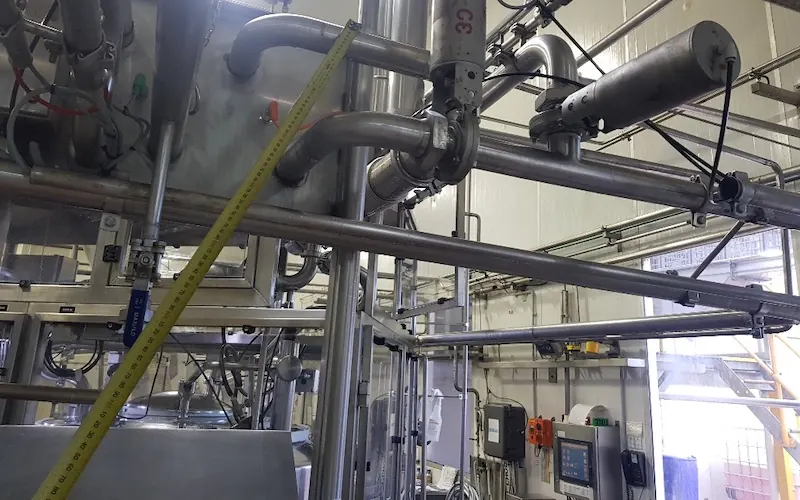
A CIP system has three parts: the CIP set that prepares and pumps the solutions, the supply and return lines that carry them, and the equipment being cleaned. A plant is usually split into several circuits.
The CIP set usually has separate tanks for rinse water, caustic detergent and acid, sometimes with a recovered-water tank and a sanitiser dosing point. A supply pump sends solution out, a heat exchanger brings it to temperature, and instruments for flow, temperature and conductivity let the control system confirm each step.
A typical cycle runs a pre-rinse to remove loose product, a hot caustic wash to remove fats and proteins, an intermediate rinse, an acid wash to remove mineral scale such as milkstone or beerstone, a final rinse, and often a sanitising step. The exact sequence, temperatures and concentrations depend on the product and soil.
Supply and return are designed differently. In pipework, the solution fills the pipe and cleans by velocity, commonly at least about 1.5 metres per second. In a tank, the solution is sprayed onto the surfaces and drains to the outlet by gravity, so a return pump is normally needed to draw it out of the tank and back to the CIP set without it pooling.
Designing Tanks That Clean Properly
Spray devices come in two broad types. Static spray balls have no moving parts and clean mainly by wetting the walls and letting solution cascade down. They suit smaller tanks and lighter soils. Rotating spray heads and jet heads turn as they spray, adding impact to the surface. They suit larger tanks, heavier soils and tanks where water and chemical use need to be kept down. The CIP supply has to deliver each device’s rated flow and pressure.
Coverage means every product-contact surface is wetted with enough flow. The roof, manways and nozzles are the usual problem areas. Agitators, baffles, dip tubes, probes and coils all cast shadows. Large or cluttered tanks may need two or more spray devices, placed so their patterns overlap.
Drainage matters as much as spraying. Tanks should have a coned or dished bottom falling to an outlet at the lowest point, with no flat areas or internal ledges. Horizontal tanks and pipework need a continuous fall to the drain point.
Avoid anything that creates a shadow or a trap. Keep nozzles short, mount instruments close to the shell, avoid capped tees and long branches (dead legs), and use sanitary connections rather than threads on product-contact surfaces. Internal welds should be smooth and fully penetrated.
A tank cooled quickly by cold rinse water after a hot wash can pull a vacuum, so the vent or vacuum relief has to be sized for CIP as well as for filling and emptying.
Verifying Coverage With Riboflavin Testing
Spray patterns on a drawing are a prediction. A riboflavin test shows what actually happens.
Riboflavin, vitamin B2, is harmless and glows under ultraviolet light. The inside of the tank is coated with a riboflavin solution, then the spray device is run at its normal CIP flow and pressure. Afterwards the tank is inspected with a UV lamp. Any area that still glows is a surface the spray did not reach or did not rinse properly.
If the test finds a shadow, the fix is usually to move or add a spray device, change the device type, or adjust flow and pressure. The tank is then tested again until coverage is complete.
On the tanks we build, we choose the spray device type and position each device for full coverage of the internal surfaces, working around nozzles, agitators and baffles. We can also arrange riboflavin coverage testing through a NATA-accredited tester.
Single-Use vs Recovery CIP
CIP sets fall into two broad types. Many plants use a combination, recovering caustic and rinse water while using fresh solution for some circuits.
| Single-use CIP | Fresh solution is made up for each clean and sent to drain afterwards. |
|---|---|
| Single-use: suits | Heavy or variable soils, small plants, pharmaceutical and high-risk products where carry-over between cleans must be avoided. |
| Single-use: trade-offs | Higher water, chemical and energy use per clean, but a simpler set with fewer tanks. |
| Recovery CIP | Caustic, acid and final rinse water are returned to holding tanks, topped up and reused for later cleans. |
| Recovery: suits | Larger plants with frequent cleans of similar soils, such as dairy and beverage. |
| Recovery: trade-offs | Lower running costs, but more tanks and instruments, and concentration and temperature have to be monitored and kept in range. |
| Either type | Needs correct flow, temperature and concentration at the equipment, not just at the CIP set. |
Adding CIP to an Existing Plant
Most CIP projects connect to equipment that is already running. Before design starts, map which tanks and lines will be cleaned together, how long each clean can take, and when each circuit is free.
Product and cleaning solution must be kept apart. Valve arrangements, such as block-and-bleed or mix-proof valves, or a physical break like a swing bend or key piece, stop chemicals reaching product while one part of the plant is cleaning and another is running.
Older tanks may have undersized spray balls or later fittings that shadow the wall, so it is worth riboflavin testing them first.
Plan the control and records side as well. Decide early how your CIP will be controlled and how cycle records will be kept, as this affects the instruments, valves and wiring we design in.
We design CIP sets, spray devices, pumps, valves and supply and return pipework, and build them in our stainless-only workshop. We can fit CIP to new tanks, or add it in our workshop to tanks you already have, including CIP/SIP for brewing and food lines, and deliver anywhere in Australia.
CIP Tank Design Checklist
Work through these points with your process engineer and fabricator before the drawings are approved.
| Circuits | Which tanks and lines are cleaned together, and how often |
|---|---|
| Cleaning cycle | Sequence, temperatures, chemical concentrations and times, agreed with your chemical supplier |
| CIP set type | Single-use, recovery or a combination, sized for the largest circuit |
| Spray devices | Static or rotating, number and position, with maker's flow and pressure range |
| Shadows | Agitators, baffles, dip tubes, probes, manways and nozzles checked against spray coverage |
| Supply flow | Enough flow and pressure at each spray device; line velocity suitable for pipe cleaning |
| Return | Return pump sized to clear the tank so solution does not pool |
| Drainage | Coned or dished bottom, outlet at the low point, pipework falling to drains |
| Dead legs | Short branches, instruments close to the shell, no capped tees |
| Venting | Vent or vacuum relief sized for rapid cooling during rinses |
| Separation | Valve arrangements or physical breaks keeping CIP solution away from product |
| Verification | How coverage will be checked; flow, temperature and conductivity records for each clean |
Questions About CIP Tank Design
For anything else, call (07) 3348 9444.
What is a CIP tank?
The term is used two ways. It can mean a tank in the CIP set that holds rinse water, caustic or acid. It can also mean a process tank designed to be cleaned in place, with spray devices, drainage and fittings that let CIP reach every surface. We design and build both.
Should I use spray balls or rotating spray heads?
Static spray balls suit smaller tanks and lighter soils and have no moving parts. Rotating heads add mechanical impact and suit larger tanks, heavier soils and plants trying to cut water and chemical use.
How do I know my tank is being cleaned properly?
A riboflavin test shows whether the spray reaches every surface. Records of flow, temperature and conductivity during each clean show that the cycle ran as designed.
Can CIP be added to an existing tank?
Usually, yes. We assess the tank first, then fit new or relocated spray devices and CIP pipework where they are needed.
Is recovery CIP always cheaper to run?
It usually uses less water and chemical per clean, but it needs more tanks and instruments and the solutions have to be kept in range. For small plants or high-risk products, single-use CIP is often the better choice.
Do you build CIP systems outside Queensland?
Yes. We design and build in our workshop, then deliver to every Australian state and territory.
Get a Quote for Your CIP System
Send us your tank list, process drawings and the products you clean, and tell us what CIP you have now. We will map the circuits, recommend spray devices and a CIP set, and quote the design, fabrication, testing and delivery. Use the form below or call us.
Other industries we build for
All industries

Stainless,
start to finish.
Tell us what you need to store, process or move. Drawings, sketches and rough numbers are all fine.
- Send your detailsCapacity, product, site and timing, as much as you know.
- We review itOur team checks the design questions and delivery needs.
- We send a quoteCovering design, fabrication, testing and delivery.
Or call (07) 3348 9444Mon–Thu 7:00 am–3:30 pm · Fri 7:00 am–1:00 pm