HomeGuidesAS 1210 Pressure Vessel Guide

AS 1210 Pressure Vessels: A Guide for Australian Buyers

What the Australian pressure vessel standard covers, how hazard levels and registration work in your state, and what to ask your fabricator before you sign off a vessel.

AS 1210 Pressure Vessels: A Guide for Australian Buyers
ASSDA accreditedSince 1996 · built and tested in our Brisbane workshop

What AS 1210 Covers

AS 1210 is the Australian Standard for pressure vessels. It sets minimum requirements for the materials, design, manufacture, testing, inspection, certification, documentation and dispatch of fired and unfired pressure vessels, whether they are welded, brazed, cast, forged, clad or lined.

In practice that means process vessels, receivers, separators, heat exchanger shells, reactors, jacketed vessels and pressurised storage. For a food, beverage, dairy, wine or pharmaceutical plant it typically includes jacketed process vessels, pressurised tanks such as brite tanks, and the jackets on otherwise atmospheric tanks when the heating or cooling medium runs under pressure, depending on the design pressure and size.

The standard covers how the shell, heads, nozzles and openings are calculated, which materials may be used and at what allowable stress, the weld joints permitted in the pressure boundary, the extent of non-destructive examination, the pressure test before service, and the nameplate and records that go with the vessel.

AS 1210 sits within the AS/NZS 1200 family of pressure equipment standards, which point to separate standards for hazard levels, welding qualification, examination, conformity assessment, piping and in-service inspection. The current edition is AS 1210-2010 with its amendments; check the Standards Australia catalogue for the latest status before you write a specification.

This guide is a plain-English summary for buyers and plant engineers. It does not replace the standard, your state regulator’s guidance or a qualified pressure vessel designer.

When a Tank Is a Pressure Vessel

A tank that is open to atmosphere through a properly sized vent is generally an atmospheric tank, not a pressure vessel. Once a vessel is designed to hold pressure above atmospheric, or to work under vacuum, it usually falls within the pressure equipment standards and your state’s work health and safety rules.

The grey areas are common in process plants. A tank pressurised with gas to transfer product, a vessel that is steam sterilised, a jacket fed with steam or pressurised hot water, or a tank that can pull a vacuum during CIP can all bring pressure equipment rules into play. Very small or very low-pressure vessels may sit in the lowest hazard level and need no registration, but that has to be worked out, not assumed.

If you are unsure, write down the highest pressure and temperature the vessel could see, including upsets, cleaning and sterilising, and the contents. That is the starting point for the design and for working out the hazard level.

The Standards Around AS 1210

A pressure vessel project usually touches several standards. This is what each one does, in summary.

AS/NZS 1200The umbrella standard for pressure equipment. It sets basic requirements across design, manufacture, testing, conformity assessment, installation, operation, inspection, repair and disposal, and calls up the other standards below.
AS 1210Design, materials, fabrication, examination, testing and documentation of the pressure vessel itself.
AS 4343Hazard levels. Rates pressure equipment from A (highest hazard) to E (negligible hazard) using pressure, volume, contents and service factors.
AS 3920Conformity assessment. Sets the level of independent checking of design and fabrication, scaled to the hazard level.
AS/NZS 3992Welding and brazing qualification. Covers qualified welding procedures and the qualification of the welders who use them.
AS 4037Examination and testing. Covers the non-destructive examination methods and acceptance criteria for welds in pressure equipment.
AS 4041Pressure piping. Piping connected to a vessel is designed and examined to this standard, not to AS 1210.
AS/NZS 3788In-service inspection. Covers inspection, repair, alteration and re-rating of pressure equipment once it is in use.

Hazard Levels

AS 4343 places pressure equipment into one of five hazard levels. The level drives how much independent checking the design and fabrication need, and whether the design and the vessel must be registered. The hazard level is calculated by the designer from the vessel’s actual duty; this table is a summary only.

Hazard level AHigh hazard. Typically large vessels or harmful contents.
Hazard level BMedium hazard. Covers many shop-fabricated process vessels.
Hazard level CLow hazard. Smaller vessels or less harmful contents.
Hazard level DExtra low hazard. Small vessels and low-hazard contents.
Hazard level ENegligible hazard. Generally outside registration, but still covered by general plant safety duties.
RegistrationUnder the model WHS regulations, design registration generally applies to hazard levels A to D and item registration to levels A to C, with some exceptions. Check your state's rules.
What sets the levelDesign pressure, volume, the type and harmfulness of the contents, and service and location factors.

Design Registration vs Plant Item Registration

Two different registrations often get confused, and they are made by different people at different times.

Design registration registers the design of the vessel. The designer, or the person commissioning the design, applies to the regulator, usually before or during manufacture. The application normally includes general arrangement or representative drawings, the technical standards used, and a design verification statement from a competent verifier who was not involved in the design. The verifier checks the design drawings and calculations. Once registered, the design has a registration number that goes on the drawings and the nameplate.

Plant item registration registers the individual vessel at your workplace. It is the job of the person with management or control of the vessel, usually the owner, and is done before the vessel is used. It generally relies on the design already being registered, and the application includes a statement that a competent person has inspected the vessel and found it safe to operate. If the vessel moves to another site or changes owner, the registration may need updating.

The rules vary between jurisdictions. Most states and territories follow the model work health and safety laws, which set out which pressure equipment needs design and item registration. Victoria has its own occupational health and safety regulations, so the requirements there differ in detail. Forms, fees and how a design registered in one state is recognised in another also differ. Confirm the requirements with the regulator where the vessel will be installed, not where it is built.

If your plant is in more than one state, or the vessel may move, raise it at quote stage so the design registration suits every place the vessel could operate.

Materials: Choosing a Stainless Grade

AS 1210 lists the materials that may be used for pressure-retaining parts and the stresses they can be designed to. Austenitic stainless steels such as 304, 304L, 316 and 316L are widely used for process vessels, and duplex and other higher alloys are used where the duty is more demanding.

For a pressure vessel, the grade has to satisfy two things at once: the pressure design at the operating temperature, and corrosion resistance against the product and your cleaning chemicals. A grade that is strong enough but pits in a chloride-rich product is not a sound choice.

Low-carbon grades such as 316L are often chosen for welded vessels because they reduce the risk of corrosion along the welds. Chlorides and high temperatures together raise the risk of stress corrosion cracking in austenitic grades, which is one reason duplex grades are considered for some duties.

Every plate, pipe and fitting in the pressure boundary should be traceable to its material certificate. Ask for the grade of each part to be shown on the approval drawing. Our Food-Grade Tank Guide covers 304, 316 and 316L in more detail.

Fabrication and Welding Qualifications

Welds in the pressure boundary are where AS 1210 asks the most of a fabricator. The standard sets out classes of construction (Class 1, 2A, 2B and 3), which link the design stresses and weld joint efficiencies to the amount of non-destructive examination carried out. Class 1 generally calls for the most examination and allows the most efficient design, while the lower classes use less examination and more conservative design values.

Every pressure weld should be made to a qualified welding procedure, by a welder qualified to that procedure. AS/NZS 3992 sets out how both are qualified. Ask your fabricator for the welding procedure specifications and the welder qualification records that will apply to your vessel. Our welders and welding procedures are qualified to AS/NZS 3992 and ASME IX, and the WPS/PQR records come with every vessel.

Non-destructive examination, such as radiography and dye penetrant, checks the welds to the extent the class of construction requires, with acceptance criteria from AS 4037. Records of who examined what, and the results, form part of the vessel’s documentation.

Depending on the hazard level, an independent inspection body may need to review the fabrication, witness key stages and the pressure test, and confirm the vessel matches the registered design. Agree up front who that will be and which hold points they need to attend, so the programme allows for it.

Hydrostatic Testing and Final Inspection

Before a pressure vessel goes into service it is pressure tested to prove its strength and tightness. A hydrostatic test, using water, is the usual method because water stores little energy and a failure is far less dangerous than with gas. AS 1210 sets the test pressure relative to the design pressure and the conditions for holding and inspecting the vessel under test; your designer will show the test pressure on the drawing.

For stainless vessels, the quality of the test water matters. Water high in chlorides left standing in an austenitic stainless vessel can start corrosion, so low-chloride water is commonly specified, and the vessel is drained and dried promptly afterwards.

Jackets are tested as well as the vessel. Where a vessel has a jacket, both the inner vessel and the jacket space are designed and tested for their own pressures and for the case where one side is under pressure and the other is not.

After the test, the vessel is given its final inspection, the nameplate is fitted and the records are compiled. A manufacturer’s data report usually gathers the drawings, calculations, material certificates, welding records, examination reports and the pressure test certificate in one place.

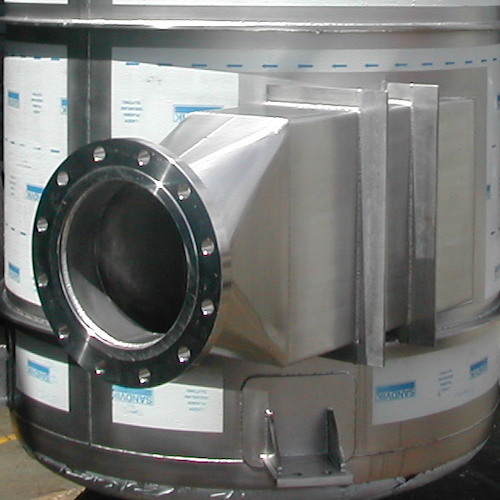
Close-up of a stainless steel flange on a vessel in the STA workshop

How We Test and Document Vessels

We hydrostatically or air test every vessel in our Murarrie workshop, with hydrostatic testing depending on the size of the vessel, and carry out dye penetrant testing of the welds and a pre-delivery inspection there too. Radiography is arranged through a NATA-accredited third party, any other testing your specification calls for (for example borescope inspection, riboflavin coverage testing, surface finish (profilometer) checks and material verification) can be arranged through NATA-accredited third-party testers, and the results go into your manufacturer’s data report.

Every vessel comes with our standard manufacturer’s data report (MDR), including material certificates, WPS/PQR and NDT records. Our AS 1210 designs are verified by a third-party RPEQ.

You or your inspector are welcome to witness the test at our workshop. Independent witnessing of fabrication and testing can be arranged through our third-party engineers.

  • Dye penetrant testing of welds in our workshop
  • Radiography of welds, arranged through a NATA-accredited third party
  • Hydrostatic and air testing of vessels and jackets in our workshop
  • Test records handed over with the vessel
  • MDR with material certificates, WPS/PQR and NDT records
  • AS 1210 design verified by a third-party RPEQ
In-Service Inspection Under AS 3788

AS/NZS 3788 sets out how pressure equipment is inspected once it is in service, from commissioning to disposal, and how repairs, alterations and re-rating are carried out.

The standard gives inspection intervals for different types of equipment, and allows those intervals to be varied where a documented risk-based engineering assessment supports it. Your regulator, insurer and the vessel’s condition all affect the plan, so check the current standard and your state’s rules rather than relying on a rule of thumb.

Inspections are carried out by a competent inspector and typically include external and internal visual checks, thickness readings and a check of safety valves and other protective devices. Stainless process vessels that are cleaned and sterilised every day can still suffer from pitting, cracking near welds or damage to jackets, so an internal look matters.

Any repair or alteration to the pressure boundary has to be done to a qualified procedure and recorded, and some alterations need the design registration updated before the vessel goes back into service. Talk to the original designer or a competent pressure vessel engineer before modifying nozzles, jackets or supports.

We design, build and test new vessels in our workshop. We do not carry out in-service inspections, but a vessel built with good access and a complete manufacturer’s data report is much easier for your inspector to work with. Our pressure vessel inspection guide covers what to expect.

Our AS 1210 Pressure Vessels

We design and fabricate custom stainless pressure vessels for food, beverage, dairy, wine, pharmaceutical and chemical plants across Australia. We design to AS 1210 in house, have each design verified by a third-party RPEQ, and arrange design registration where your state requires it.

Vessels are built in 304, 316, 316L and higher alloys in our stainless-only workshop by welders and welding procedures qualified to AS/NZS 3992 and ASME IX, then inspected and pressure tested in our workshop before delivery. We have supplied tanks to New South Wales, South Australia, Western Australia, Darwin and Fiji as well as across Queensland. We have been an ASSDA Accredited Fabricator since 2009.

  • Built to AS 1210
  • Design registration arranged where required
  • Jacketed, horizontal and vertical vessels
  • Hygienic internals, food-grade 0.6 µm Ra finish and CIP for food and pharma duties
  • Delivered nationally
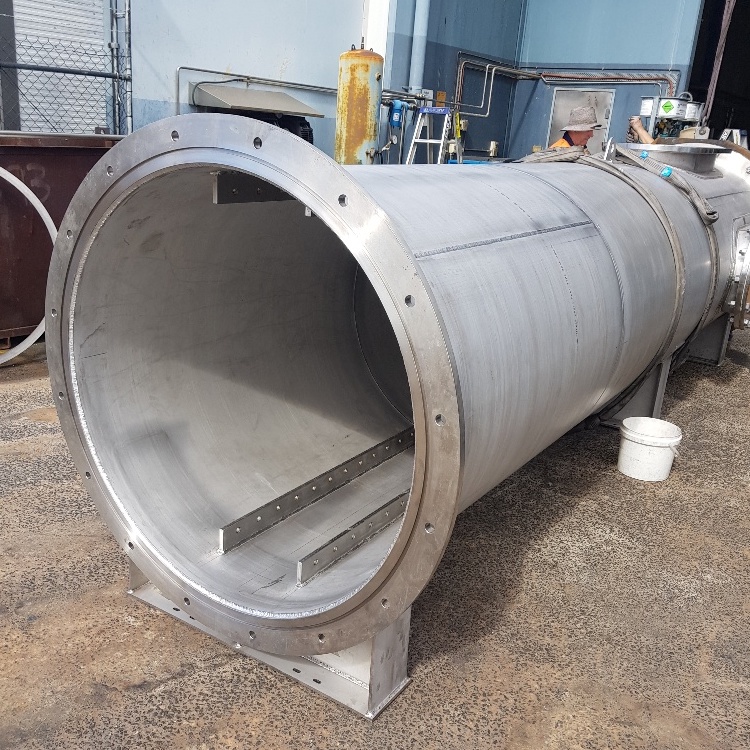
Stainless steel vessel shell in the STA workshop

AS 1210 Pressure Vessel Buyer Checklist

Use this list when you brief a fabricator or review a quote. Ask for the documents up front.

DutyProduct, design pressure and vacuum, design temperature range, volume, and cleaning and sterilising conditions
Hazard levelHazard level to AS 4343, worked out by the designer and shown on the drawing
RegistrationWho registers the design, in which state or states, and what you need for item registration
Design verificationWho verifies the design and how independent checking is arranged for the hazard level
MaterialsGrade for every pressure part, shown on the drawing, with traceable material certificates
Class of constructionClass of construction and the extent of radiography or other examination it requires
WeldingQualified welding procedures and welder qualifications for the pressure welds
JacketsJacket type, jacket design pressure and temperature, and how the jacket will be tested
Relief devicesSafety valve or bursting disc sizing and set pressure, and who supplies them
Pressure testTest method and pressure on the drawing, test water quality for stainless, and who witnesses it
Hygienic designFinish, drainability and CIP coverage where the vessel holds food, dairy or pharmaceutical product
DocumentsManufacturer's data report, nameplate details and test certificates handed over with the vessel
In serviceAn inspection plan to AS/NZS 3788 and who will carry out the first inspection

Questions About AS 1210 Pressure Vessels

For anything else, call (07) 3348 9444.

What is AS 1210?

AS 1210 is the Australian Standard for pressure vessels. It sets minimum requirements for the materials, design, fabrication, examination, testing and documentation of fired and unfired pressure vessels. It works alongside AS/NZS 1200 and related standards for hazard levels, welding, examination and in-service inspection.

What is the difference between AS 1210 and AS/NZS 1200?

AS/NZS 1200 is the umbrella standard for all pressure equipment, including boilers and piping. AS 1210 is the specific standard for designing and building pressure vessels. AS/NZS 1200 calls up AS 1210 for vessels.

Do all pressure vessels need to be registered?

No. Registration depends on the hazard level under AS 4343 and the rules in your state or territory. Higher hazard vessels generally need both design and item registration, lower hazard vessels may need design registration only, and negligible hazard vessels generally need neither. Check with your regulator.

Who is responsible for design registration and item registration?

Design registration is usually arranged by the designer or the person who commissions the design. Item registration is the owner's responsibility before the vessel is used at the workplace. Your fabricator can often help with both.

Is design registration in one state accepted in another?

Most jurisdictions recognise designs registered under corresponding laws elsewhere, but the detail varies, and Victoria runs its own regulations. Tell your fabricator every state where the vessel may be installed.

Can a vessel be designed to ASME instead of AS 1210?

The pressure equipment framework in Australia allows other recognised standards in some cases, but the design still has to satisfy Australian registration and conformity assessment requirements. For vessels built and installed in Australia, AS 1210 is the usual choice.

How often do pressure vessels need to be inspected?

AS/NZS 3788 sets inspection intervals by equipment type and allows them to be varied by a risk-based assessment. Your regulator, insurer and the vessel's condition also affect the plan, so ask a competent inspector to set it.

Is a jacketed tank a pressure vessel?

It can be. If the jacket carries steam, pressurised hot water or glycol under pressure, the jacket may be pressure equipment even when the inner tank is atmospheric. The designer works out the hazard level for each pressure space.

Do you build AS 1210 pressure vessels for interstate sites?

Yes. We build stainless pressure vessels to AS 1210 in our workshop and send them interstate. We have supplied tanks to New South Wales, South Australia, Western Australia, Darwin and Fiji as well as across Queensland. We design to AS 1210 in house, with each design verified by a third-party RPEQ, and arrange design registration where required.

Get a Quote for Your Pressure Vessel

Send us your duty sheet: product, design pressure and temperature, volume, any jacket duty and the state where the vessel will be installed. We will confirm what applies, then quote the design, fabrication, testing and documentation. Use the form below or call us.

Stainless tanks built by STA

Stainless,
start to finish.

Tell us what you need to store, process or move. Drawings, sketches and rough numbers are all fine.

  1. Send your detailsCapacity, product, site and timing, as much as you know.
  2. We review itOur team checks the design questions and delivery needs.
  3. We send a quoteCovering design, fabrication, testing and delivery.

Or call (07) 3348 9444Mon–Thu 7:00 am–3:30 pm · Fri 7:00 am–1:00 pm

Request a quote